Khalis

The Quran, with nothing in the way

All 114 surahs in the Uthmani script, with Pickthall’s English, Tafsir al-Jalalayn and tajweed in colour. All of it is inside the app, so it opens with or without a connection. Only recitation goes online, when you press play or save a surah.

  • 114surahs, offline
  • 6,236verses
  • 30juz
  • 6reciters
On this page
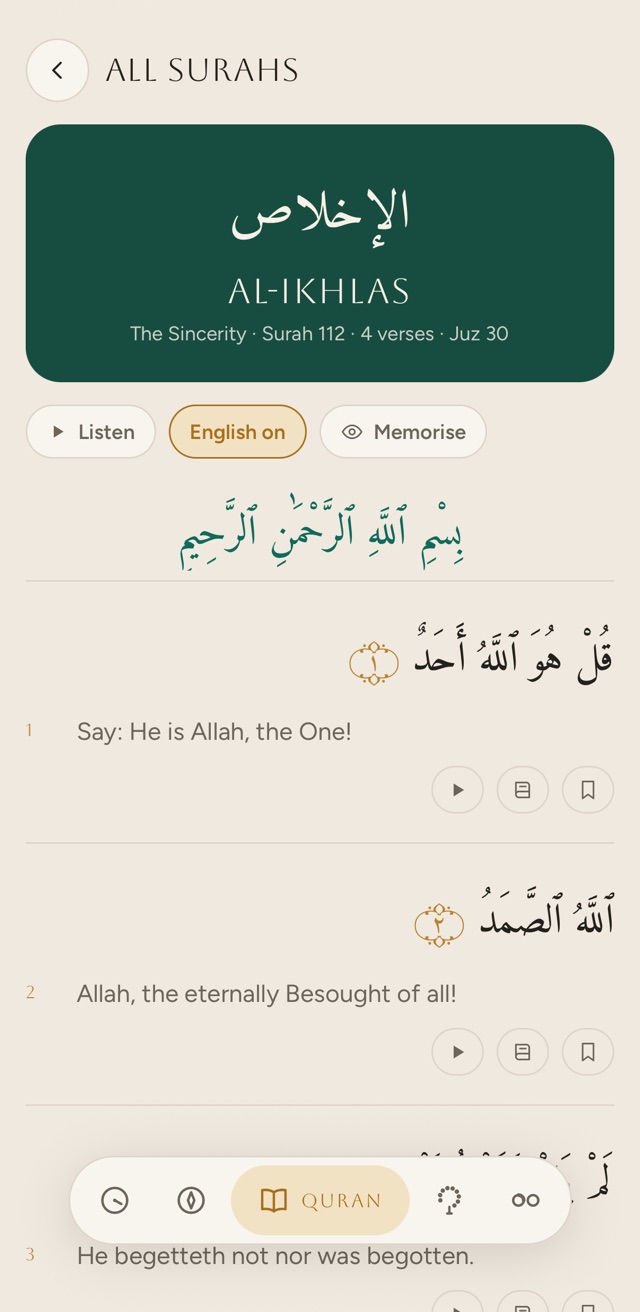
Surah Al-Ikhlas in Khalis. A green header with the Arabic name, Al-Ikhlas, and ‘The Sincerity · Surah 112 · 4 verses · Juz 30’; buttons for Listen, English on and Memorise; the Basmala on its own line; then verses 1 and 2 in Arabic, each with Pickthall’s English beneath and buttons to play, open the tafsir and bookmark.
Al-Ikhlas, with English on
Reading

Open any surah, or any juz

The Uthmani text of the Tanzil Project, copied letter for letter. It is part of the app rather than fetched from anywhere, so a surah opens straight away.

  • The surah list. Each surah with its number, its name and meaning, how many verses it has, and its name in Arabic.
  • By juz. All 30, each opening at the verse where it begins, in the standard Madani division that Tanzil publishes.
  • Carry on where you stopped. As you read, Khalis notes the verse at the top of the screen. The Continue reading card takes you back to it, and shows its juz.
  • Bookmarks. Tap the bookmark beside any verse. The Saved tab keeps them, newest first.
  • Set out like a mushaf. The Basmala on its own line, and each verse closed by its number in the verse-end ornament.
  • Surah to surah. The next and the previous surah are waiting at the end of each one.
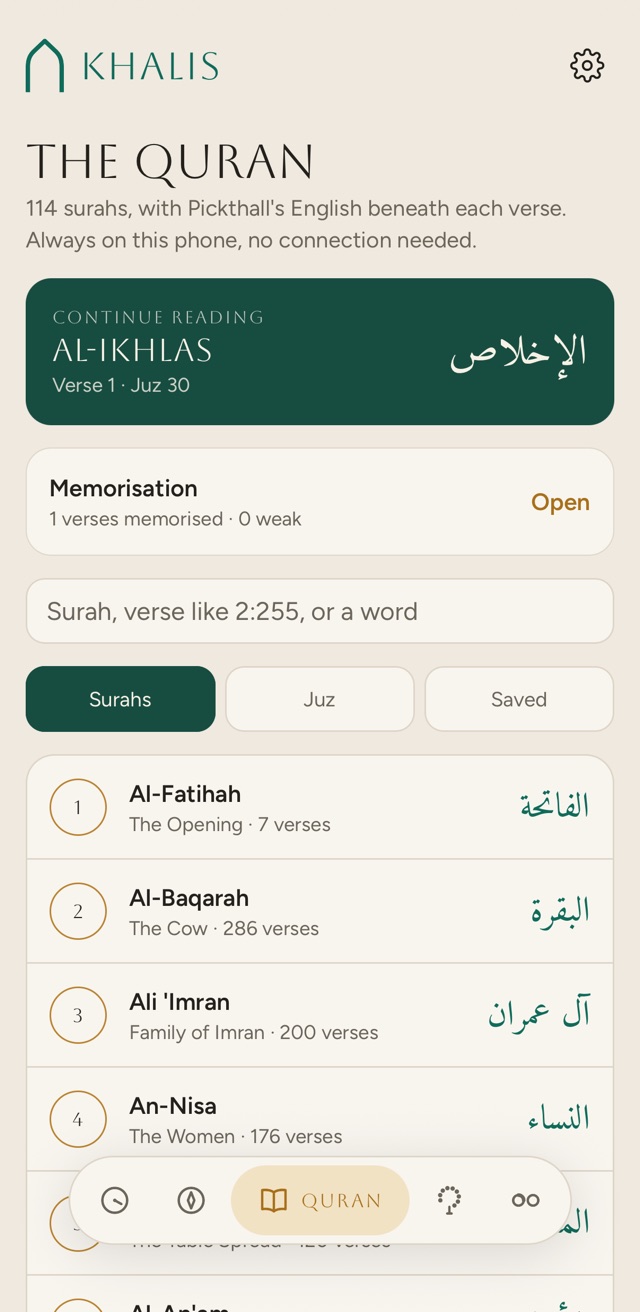
The Quran screen in Khalis: ‘114 surahs, with Pickthall’s English beneath each verse. Always on this phone, no connection needed.’ Below are a Continue reading card for Al-Ikhlas, verse 1, Juz 30; a Memorisation card; the search box, ‘Surah, verse like 2:255, or a word’; tabs for Surahs, Juz and Saved; and the list of surahs from Al-Fatihah, Al-Baqarah and Ali ’Imran, each with its meaning, its number of verses and its Arabic name.
The surah list, with Continue reading at the top
Translation and tafsir

The meaning, beneath the words

An English translation under each verse, and a classical commentary in Arabic a tap away.

English

Pickthall’s translation

Say: He is Allah, the One!

Al-Ikhlas 112:1, in Pickthall’s words

Marmaduke Pickthall’s The Meaning of the Glorious Koran (1930) sits beneath each verse, as Tanzil publishes it.

  • On, or the Arabic alone. English is on to begin with. Tap it at the top of any surah to turn it off, and it stays off in every surah until you turn it back on.
  • Searchable. Type a word of three letters or more in the search, and Khalis finds the verses where it appears in his English.
Tafsir

Tafsir al-Jalalayn

تفسير الجلالين By Jalal al-Din al-Mahalli and Jalal al-Din al-Suyuti, in Arabic

The classical commentary, digitised by Quranpedia. Tap the book beside a verse and its commentary opens just beneath it.

  • The verse picked out. Where the commentary quotes the verse, those words are set in the Quran’s own typeface.
  • Verses explained together. Where Jalalayn covers several verses at once, Khalis says so and shows that passage. Where it has nothing separate on a verse, Khalis says that too.
Tajweed

See the rules as you read

Turn on Tajweed at the top of a surah and the letters take the colours of the familiar colour-coded mushafs: grey for letters you don’t pronounce, gold to dark red for the lengths of madd, green for ghunnah and blue for qalqalah. A key sits above the verses.

قريش Quraysh Quraysh · Surah 106 · 4 verses · Juz 30
  • Not pronounced
  • Madd, 2 counts
  • Madd, 2, 4 or 6
  • Madd, 4 or 5
  • Madd, 6 counts
  • Ghunnah
  • Qalqalah

بِسْمِ ٱللَّهِ ٱلرَّحْمَٰنِ ٱلرَّحِيمِ

  1. لِإِيلَٰفِ قُرَيْشٍ

    106:1For the taming of Qureysh.

  2. إِۦلَٰفِهِمْ رِحْلَةَ ٱلشِّتَآءِ وَٱلصَّيْفِ

    106:2For their taming (We cause) the caravans to set forth in winter and summer.

  3. فَلْيَعْبُدُوا۟ رَبَّ هَٰذَا ٱلْبَيْتِ

    106:3So let them worship the Lord of this House,

  4. ٱلَّذِىٓ أَطْعَمَهُم مِّن جُوعٍ وَءَامَنَهُم مِّنْ خَوْفٍۭ

    106:4Who hath fed them against hunger and hath made them safe from fear.

Quraysh 106:1–4, coloured by the app’s own tajweed data. Arabic text: Tanzil Project, tanzil.net (Uthmani, CC BY 3.0). English: Marmaduke Pickthall (1930). Tajweed: quran-tajweed by Collin Fair (CC BY 4.0), grouped by Khalis into these seven colours.
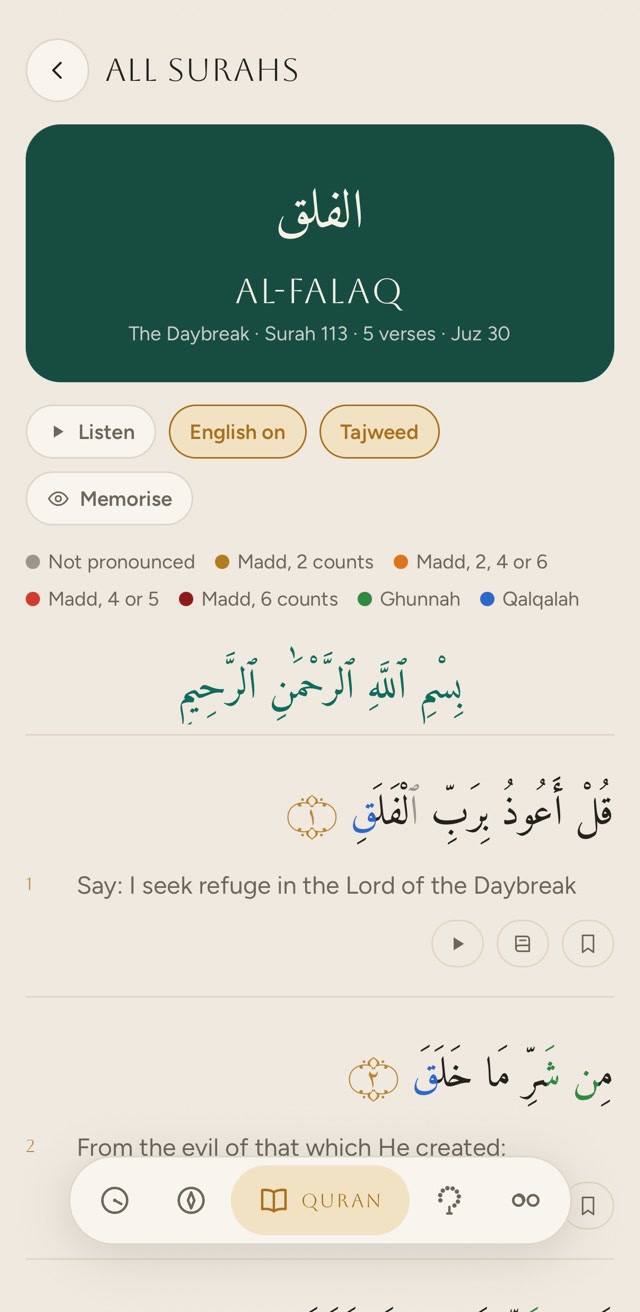
Surah Al-Falaq in Khalis with Tajweed on. Under the green header, ‘The Daybreak · Surah 113 · 5 verses · Juz 30’, the English on and Tajweed buttons are lit, and the colour key reads Not pronounced, Madd 2 counts, Madd 2, 4 or 6, Madd 4 or 5, Madd 6 counts, Ghunnah and Qalqalah. Below the Basmala is verse 1. In its last word the opening alif is grey, as it is not pronounced, and the final letter is blue, for qalqalah. Pickthall’s English is beneath.
Al-Falaq with Tajweed on, in the app
  • Off until you want it

    Tajweed starts off. Turn it on once and it stays on for every surah.

  • With the recitation

    With a reciter whose words light up, the word being recited gets a soft background, so its colours stay as they are.

  • In dark mode

    The same seven colours, in shades chosen to read well on a dark page.

The key, word by word

Where each colour falls in Quraysh

The tajweed data marks 18 rules. Khalis groups them into seven colours, and these are the words of Quraysh that carry each one.

  • Not pronounced

    Hamzat al-wasl, lam shamsiyyah, silent letters, and idghaam without ghunnah, mutajanisayn and mutaqaribayn

    ٱلشِّتَآءِ106:2 وَٱلصَّيْفِ106:2 فَلْيَعْبُدُوا۟106:3 ٱلْبَيْتِ106:3

  • Madd, 2 counts

    Madd of two counts

    لِإِيلَٰفِ106:1 إِۦلَٰفِهِمْ106:2 هَٰذَا106:3

  • Madd, 2, 4 or 6

    Madd of two, four or six counts, and madd munfasil

    قُرَيْشٍ106:1 وَٱلصَّيْفِ106:2 ٱلْبَيْتِ106:3 ٱلَّذِىٓ106:4 خَوْفٍۭ106:4

  • Madd, 4 or 5

    Madd muttasil

    ٱلشِّتَآءِ106:2

  • Madd, 6 counts

    Madd of six counts

    None in Quraysh. The first in the Quran is in Al-Fatihah: ٱلضَّآلِّينَ1:7

  • Ghunnah

    Ghunnah, idghaam with ghunnah, ikhfa, iqlab, ikhfa shafawi and idghaam shafawi

    أَطْعَمَهُم106:4 مِّن106:4 جُوعٍ106:4 وَءَامَنَهُم106:4 مِّنْ106:4

  • Qalqalah

    Qalqalah

    أَطْعَمَهُم106:4

Recitation

Six reciters, verse by verse

Press play beside any verse, or Listen at the top of a surah, and the recitation carries on from there to the end of the surah. Mishary Alafasy recites until you choose someone else.

The reciters in Khalis
ReciterWords light up
Mishary AlafasyYes
Mohamed Siddiq al-MinshawiYes
Abu Bakr ash-ShaatreeYes
Hani ar-RifaiYes
Abdur-Rahman as-SudaisNo
Mahmoud Khalil al-HusaryNo

With four of them, each word lights up as it is recited, so you can follow along.

  • Speed

    Slower to learn, quicker to revise. The pitch stays the same, so a reciter still sounds like themselves, and the highlighting keeps time.

    • 0.75×
    • Normal (to start with)
    • 1.25×
    • 1.5×
  • Repeat a verse

    Hear each verse again before moving on, or keep one verse going until you stop it.

    • Once (to start with)
    • 3×
    • 5×
    • Loop
  • Up to a verse

    Play from where you start to a verse you choose, then stop, or go round that passage again.

    • Once (to start with)
    • 3×
    • 5×
    • Loop
  • Screen locked

    It keeps playing with the screen locked or while you use another app, with the surah, verse and reciter on the Lock Screen controls. On iPhone it plays even with the phone set to silent.

  • Offline

    Download a surah for the reciter you have chosen and it plays from your phone, with no connection at all. You can stop a download partway, and remove it later.

  • The player

    A small bar floats over the Quran screens while a recitation plays. It shows the verse and the reciter, the speed when it isn’t normal, and “offline” for a saved surah, with buttons for the previous and next verse, pause, these settings, and stop.

The one time this part of Khalis goes online. Reading, the English, the tafsir, tajweed and search all work from the app itself. Recitation is streamed, a verse at a time, from the free Islamic Network library (cdn.islamic.network) when you press play, or downloaded from there when you save a surah. Each request is simply for that verse’s recording.

Questions

About the Quran in Khalis

Do I need a connection to read?

No. The Arabic text, Pickthall’s English, Tafsir al-Jalalayn, the tajweed colours and the search are all inside the app. Only recitation is streamed, and a surah you have downloaded plays without a connection too.

Can I choose another translation?

Pickthall’s is the one English translation in Khalis today. You can turn it off to read the Arabic on its own.

Why do the words light up for only four reciters?

The word timings come from quran-align by Collin Fair. Khalis uses them for the four reciters whose recordings, as streamed, are byte for byte the ones the timings were made from: Alafasy, al-Minshawi, ash-Shaatree and ar-Rifai. The as-Sudais timings in that release are damaged, so they aren’t used. As-Sudais and al-Husary play verse by verse, without the highlighting.

Where are my bookmarks and my place kept?

On your phone, with the rest of what Khalis keeps. They go into a backup file if you make one, and on iPhone, with iCloud sync turned on, they follow you to your other Apple devices. Downloaded recitations stay on the phone that saved them.

Is the Arabic text changed in any way?

No. It is the Tanzil Project’s Uthmani text, copied verbatim, as Tanzil’s terms ask. Where the Basmala opens a surah, Khalis shows it on its own line above the first verse, as a printed mushaf does, but the words are Tanzil’s.

With thanks

Where the Quran in Khalis comes from

Quran textUthmani script from the Tanzil Project, used verbatim under CC BY 3.0. The juz follow the standard Madani division, as Tanzil publishes it.

English translationMarmaduke Pickthall, The Meaning of the Glorious Koran (1930), via Tanzil.

TafsirTafsir al-Jalalayn, by Jalal al-Din al-Mahalli and Jalal al-Din al-Suyuti, digitised by Quranpedia.

Tajweed coloursquran-tajweed by Collin Fair, CC BY 4.0. Khalis groups its rules into seven colours, and has moved each marked range onto Tanzil’s current text, which writes a few marks differently from the 2017 text the data was made from.

RecitationsStreamed from the Islamic Network library, free for non-commercial use, with each reciter credited.

Word timingsquran-align by Collin Fair, CC BY 4.0.

Every source and licence