Hold on to what you learn
Memorise mode hides what you are learning, so you recite first and check after. A revision schedule and a short quiz bring each verse back, and your record is kept on your phone.
- 7revision steps, 1 to 120 days
- 4ways to quiz yourself
- 1,550verses marked as easily confused
Learn a verse, then keep it
When you first open Memorisation, Khalis explains itself in four steps. These are its own words.
Read and listen
Open a surah, play the recitation, and repeat a verse until it feels familiar.
Recite from memory
Turn on Memorise. Each verse hides behind its first word. Recite it, reveal it, and say whether you had it.
Mark what you know
Tap Memorised on verses you know. They come back for revision tomorrow, then after 3, 7, 14, 30, 60 and 120 days.
Revise a little each day
Due verses wait in the quiz. Any you miss come back the next day, marked weak.
Start with a short surah Khalis offers five to begin with: Al-Fatihah, Al-Ikhlas, Al-Falaq, An-Nas and Al-’Asr.
Recite first, then look
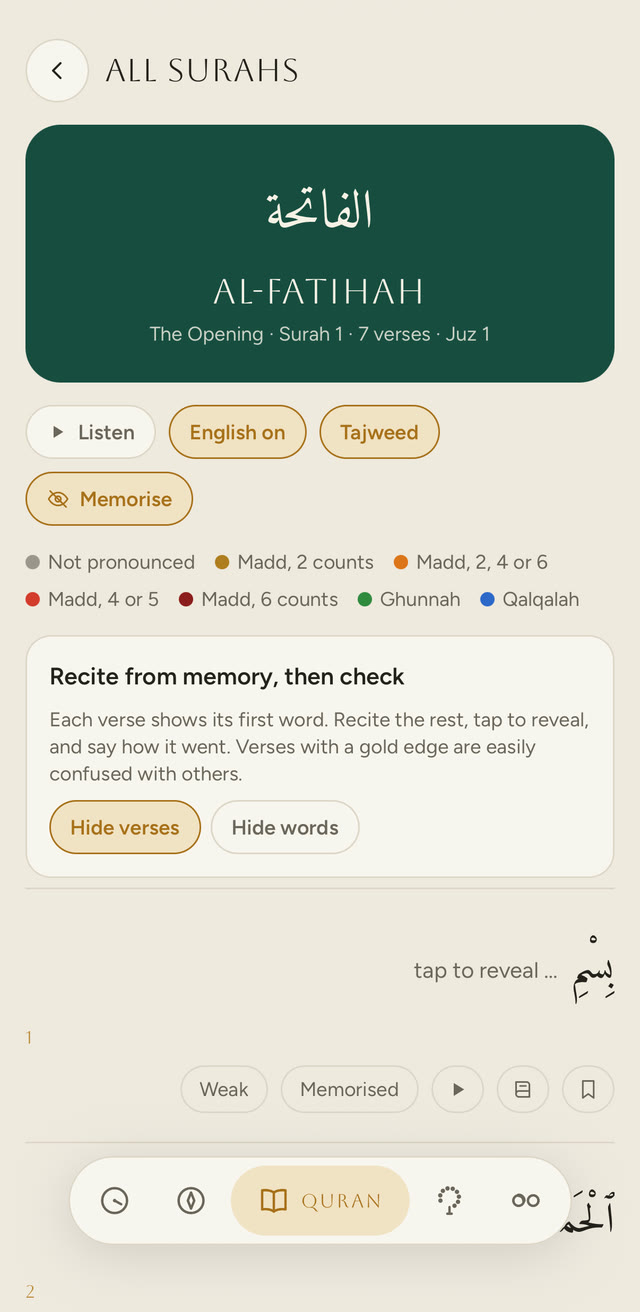
Memorise is a switch at the top of each surah, beside Listen, English and Tajweed. Turn it on and the surah becomes a place to test yourself.
- Hide verses. Each verse keeps its first word as a cue. Recite the rest, then reveal it.
- Hide words. Every word is hidden. Tap a word to peek at it. Once you have peeked, you can show the whole verse.
- Did you have it? Once you look, answer Had it or Missed it. Your answer sets when the verse comes back.
- Weak and Memorised. Two buttons under each verse, to mark it yourself.
- The English stays hidden too, until the verse is shown.
- Each session is noted. While Memorise is on, Khalis keeps the time spent, the verses you went through, and how many you had. Under ten seconds with nothing answered isn’t counted.
Memorise mode, on this page
The seven verses of Al-Fatihah, as Khalis shows them.
بِسْمِ ٱللَّهِ ٱلرَّحْمَٰنِ ٱلرَّحِيمِ
ٱلْحَمْدُ لِلَّهِ رَبِّ ٱلْعَٰلَمِينَ
ٱلرَّحْمَٰنِ ٱلرَّحِيمِ
مَٰلِكِ يَوْمِ ٱلدِّينِ
إِيَّاكَ نَعْبُدُ وَإِيَّاكَ نَسْتَعِينُ
ٱهْدِنَا ٱلصِّرَٰطَ ٱلْمُسْتَقِيمَ
صِرَٰطَ ٱلَّذِينَ أَنْعَمْتَ عَلَيْهِمْ غَيْرِ ٱلْمَغْضُوبِ عَلَيْهِمْ وَلَا ٱلضَّآلِّينَ
Nothing checked yet.
Arabic text: Tanzil Project (Uthmani, CC BY 3.0). English: Marmaduke Pickthall. Nothing you do here is saved or sent.
A gap that grows each time you remember
Mark a verse memorised and it goes on a schedule. Each time you recall it, the wait before the next revision grows, up to 120 days. Miss it, and it starts again.
From the day you mark it
- Mark it
Tap Memorised on a verse and its first revision is tomorrow.
- Recall it
The wait grows: 3 days, then 7, 14, 30, 60 and 120. After that, it comes back every 120 days.
- Miss it
It comes back tomorrow, marked weak, and climbs from the first step again. Recalling it later clears the mark.
- Any verse
Saying how a verse went puts it on the schedule, in Memorise mode or the quiz, even if you haven’t marked it memorised.
- Running late
A verse you don’t get to stays due until you revise it.
What’s due, and a nudge if you want one
A verse is due once its day has come. Khalis shows how many on the Memorisation card in the Quran tab, and at the top of the Memorisation screen, where one tap starts the quiz on them.
- The reminder is off until you turn on Remind me to revise, under Revision reminder.
- At an hour you choose, from 05:00 to 23:00. It starts at 20:00, or 8 pm with the 12-hour clock.
- Only when verses are due by then, and it says how many.
- Tap it and the quiz opens on today’s due verses.
- It is planned again whenever Khalis opens or the schedule changes, so the count stays current. Khalis asks for permission to send notifications when you turn it on.
 Revision · Khalis20:00
5 verses are due for revision. A few minutes keeps them strong.
What comes next?
The quiz shows you a verse and asks for the one after it. At the start of a surah, it gives the surah’s name and asks for its first verse. Recite, show the verse, and say whether you had it.
- Due
The verses whose day has come. The quiz opens here when any are due.
- Weak
The verses you missed, or marked weak yourself.
- Memorised
Every verse you have marked memorised.
- Surah
Any of the 114 surahs, with all its verses in one round.
Due and weak verses come first, shuffled together, then the rest, each in a fresh random order. At the end of a round you see how many you recalled and missed, and the ones you missed come back tomorrow.
A round on Al-Ikhlas
بِسْمِ ٱللَّهِ ٱلرَّحْمَٰنِ ٱلرَّحِيمِ
قُلْ هُوَ ٱللَّهُ أَحَدٌ
ٱللَّهُ ٱلصَّمَدُ
لَمْ يَلِدْ وَلَمْ يُولَدْ
وَلَمْ يَكُن لَّهُۥ كُفُوًا أَحَدٌۢ
Arabic text: Tanzil Project (Uthmani, CC BY 3.0). Nothing you do here is saved or sent.
A small goal, and a quiet record
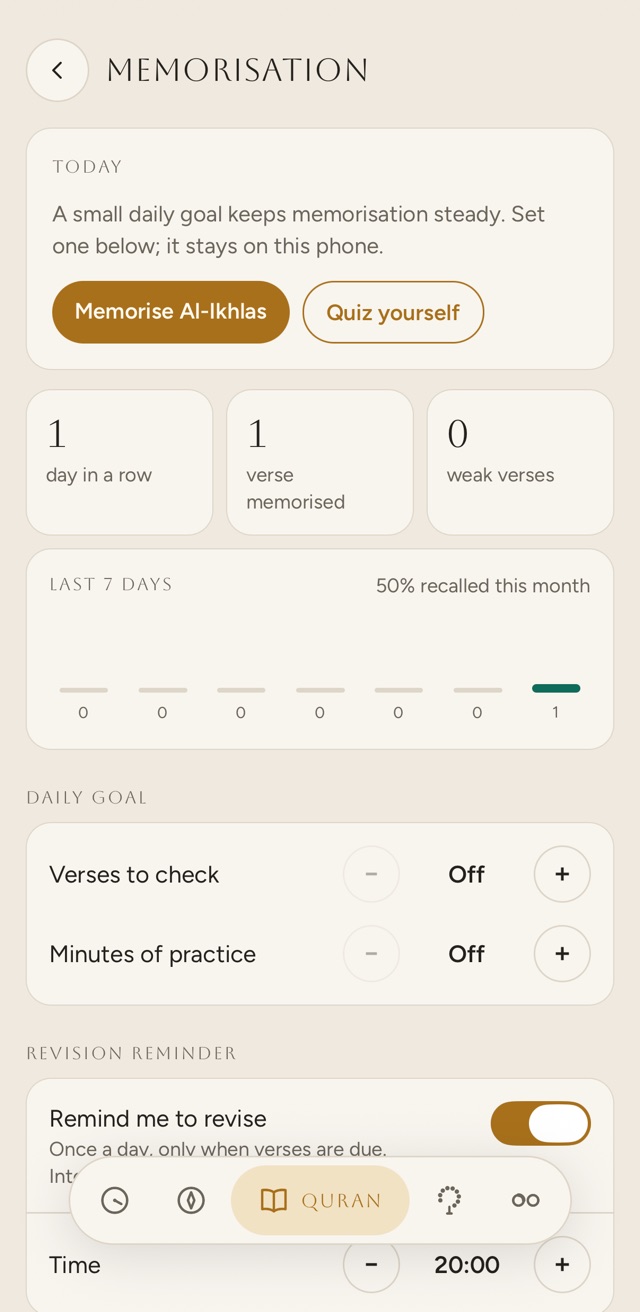
Memorisation has its own screen, a tap from the card near the top of the Quran tab. It keeps the day’s goal, your counts and your recent sessions in one place.
- A daily goal of verses to check, from 5 to 100, and minutes of practice, from 5 to 120, each in steps of five. Both are off until you set one.
- Today, with a bar for verses checked and a bar for minutes, against your goal.
- Three counts: days in a row, verses memorised and weak verses. Any day with practice keeps the run going, and today doesn’t break it before it’s over.
- The last 7 days, as the minutes you practised each day, with the share of verses you recalled over the last 30 days.
- Recent sessions: the latest 20, each with the surah and verses, the date, the time spent, and how many you recalled and missed. Quiz rounds are marked Quiz.
- Revise your weak verses: when you have any, a card starts a quiz on them.
Look-alike verses, edged in gold
Some verses share most of their words with another, and it is easy to slip from one into the other. In Memorise mode, Khalis marks them with a gold edge and lists the verses they resemble.
- 1,550 verses have at least one look-alike listed.
- Similar to: under the verse, up to six references, each a tap away.
- Only in Memorise mode, so ordinary reading stays plain.
The list is Quran Mutashabihat Data by Waqar144, from the work of the late Qari Idrees Al Asim, in the public domain (CC0). Its author notes that it is not exhaustive.
وَٱتَّقُوا۟ يَوْمًا لَّا تَجْزِى نَفْسٌ عَن نَّفْسٍ شَيْـًٔا وَلَا يُقْبَلُ مِنْهَا شَفَٰعَةٌ وَلَا يُؤْخَذُ مِنْهَا عَدْلٌ وَلَا هُمْ يُنصَرُونَ
And guard yourselves against a day when no soul will in aught avail another, nor will intercession be accepted from it, nor will compensation be received from it, nor will they be helped.
Similar to 2:123
وَٱتَّقُوا۟ يَوْمًا لَّا تَجْزِى نَفْسٌ عَن نَّفْسٍ شَيْـًٔا وَلَا يُقْبَلُ مِنْهَا عَدْلٌ وَلَا تَنفَعُهَا شَفَٰعَةٌ وَلَا هُمْ يُنصَرُونَ
And guard (yourselves) against a day when no soul will in aught avail another, nor will compensation be accepted from it, nor will intercession be of use to it; nor will they be helped.
Similar to 2:48
Yours, and on your phone
Quran text: Uthmani script from the Tanzil Project, used verbatim under CC BY 3.0. English: Marmaduke Pickthall, The Meaning of the Glorious Koran (1930), via Tanzil. Similar verses: Quran Mutashabihat Data by Waqar144 (CC0). All sources and credits